Ms Sharon (Ling Zhi) Heng MBBS, PhD, FRCOphth, FHEA Consultant Ophthalmic Surgeon

Refractive Lens Exchange (RLE)

What is Refractive Lens Exchange?

Refractive lens exchange is also known as lens replacement surgery or clear lens exchange is a vision correction surgery aimed to permanently correct the focus of one’s vision. The main aim is to keep the patient spectacle free and is a form of presbyopic correction.

How Does RLE Work?

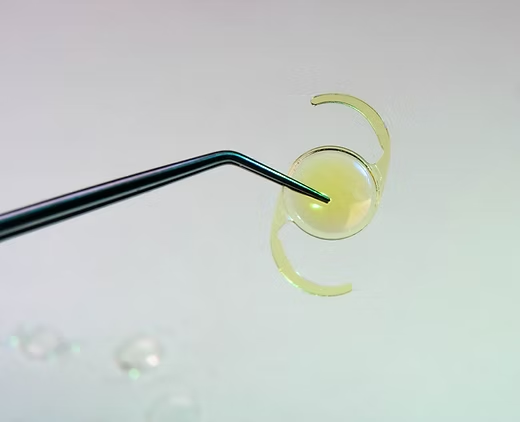
During RLE, the natural lens of the eye is removed and replaced with an artificial lens implanted during a surgery which is very similar to cataract surgery. The artificial lens implant is designed to allow multiple focusses of your vision so that one can see both in the distance, intermediate and reading or close distances with minimal or no glasses.

​The difference between RLE and cataract surgery is that this is performed before cataract develops , with the sole aim of reducing the person’s need for glasses.

How is RLE Performed?

The procedure is very similar to cataract surgery, commonly phacoemulsification. It is performed as a day procedure, lasting between 15-30 minutes per eye.

Who are Candidates of RLE?

RLE is best considered for individuals usually over 45 years of age and would like to be glasses free. Patients considered may also be those with high refractive errors or who are not candidates for LASIK. If you have early cataracts or are at higher risk of developing them, then RLE may be a procedure to consider as these can be treated simultaneously.

Cataract Removal Surgery Process

Our comprehensive cataract removal surgery process is designed to provide patients with safe, effective, and personalised care from pre-operative evaluation to post-operative recovery.

  • To correct presbyopia and refractive errors including high degrees of myopia, hyperopia and astigmatism simultaneously
  • Need for minimal spectacle correction or be spectacle free
  • Address early cataracts and negate need for future cataract surgery
  • Long lasting results- permanent solution for vision correction
  • Risks of surgery, whilst rare, significant complications can result in vision loss, infection or retina detachment.
  • Down time or adjustment period of a week. Full recovery may take few weeks to couple of months
  • Glare and halos (but this should gradually get better)
  • Dry eyes
  • Posterior capsular opacity (PCO)- a cloudy film behind implanted lens- but can be treated with a quick, painless laser procedure known as yag. capsulotomy.

What Type of Lenses are Available?

When we talk about vision, we can divide into the following: 

•  Distance Vision – approximately 4 metres away and mainly for driving
•  Intermediate Vision – examples include using a computer screen, reading using gadgets such as iPad or kindle, looking at a menu, gardening or cooking
•  Near Vision – reading newspapers or book, usually around 40cm away

We can optimise refractive outcomes in accordance to your needs for vision through several artificial or intraocular lenses implanted during the surgery.

  • Multifocal/ Trifocal lenses: These lenses correct for distance, intermediate and near vision- negating the need for glasses.  If glasses are needed, it is often a very weak prescription. The main drawback or cons for these lenses  is that it may induce glare or halos. This is  worse in dim light conditions and is exaggerated for some individuals especially those with ocular surface or ocular problems.

  • Extended Depth of Focus (EDOF)lenses: These lenses correct for distance and intermediate vision but reading glasses are likely required for close or reading work.

This is an increasingly popular option for patients with modern gadgets such as the iPad. Most of our daily living now involves mainly intermediate distances. Thus, having distance and intermediate vision may cover the vast majority of needs for many patients, particularly those with mild underlying ocular disease. This lens induced minimal glare as compared to the latter. 

Advanced Technology and Techniques

Our clinic is equipped with state-of-the-art technology and employs advanced surgical techniques to deliver safe, precise, and effective Refractive lens exchange

Customised Treatment Planning

RLE is meticulously planned and customised to address the unique visual needs and ocular characteristics of the patient. By integrating advanced diagnostic imaging, intraoperative guidance systems, and patient-specific data, surgeons can tailor the surgical approach, lens selection, and incision placement to optimise visual outcomes and patient satisfaction.

Contact us today to schedule a comprehensive consultation and take the first step towards achieving clearer vision and a brighter future. With our advanced technology, personalised care, and experienced surgical team, clear vision awaits you!

Frequently Asked Questions

Is RLE Safe?

RLE or lens replacement surgery is one of the safest as well as commonest surgeries done world wide. In Europe, approximately 3 million cases are done on a yearly basis. However, as with every procedure and surgery, there will be risks involved. Whilst complications are uncommon , it is important that you consider the risks and benefits as well as impact on you that would be discussed during your initial consultation.

RLE carries similar risks to cataract surgery which has gone through technological advancements in the last decades. Phacoemulsification technique is performed in the majority of the cases.

However, as with every medical procedure and surgeries, there are risks involved.

The risk of serious complications developing as a result of cataract surgery is estimated at around 1 in 50 cases.

These can include:

  • Blurred vision

  • Some loss of vision

  • Detached retina – where the the thin layer at the back of your eye (retina) becomes loose

Most of these serious complications can be treated with either medicine or surgery.

There is a very small risk – around 1 in 1,000 – of permanent sight loss in the treated eye as a direct result of the operation.

Ms Heng will individualise your risk profile and define the possible complications and outcomes as well as risk vs benefit profile for the individual patients.

Immediately following the RLE surgery, you may experience some improvements in your vision which will improve over time. Full recovery from RLE usually takes a few weeks to a couple of months. Most patients however resume normal activities within a week or two.

Not to worry if your vision fluctuates in the first couple of weeks, you may also experience blurriness, glare, or halos around lights. These effects are expected and gradually subside as your eyes heal with time.

Refractive Lens Exchange (RLE) also known as lens replacement surgery or clear lens exchange is a surgical procedure that involves replacing the natural lens with an artificial one and if aimed to correct refractive errors such as nearsightedness, farsightedness, and astigmatism. Refractive eye surgery such as LASIK and PRK,reshapes the cornea to correct vision.

RLE can be considered for patients who are poor candidates for LASIK due to high refractive errors, thin corneas, or age-related changes in the eye.

It is also a popular solution for individuals over the age of 45 experiencing presbyopia (difficulty in seeing close or reading distance). RLE is able to address both refractive errors and presbyopia simultaneously.

The cost for surgery begins from £3095 per eye.