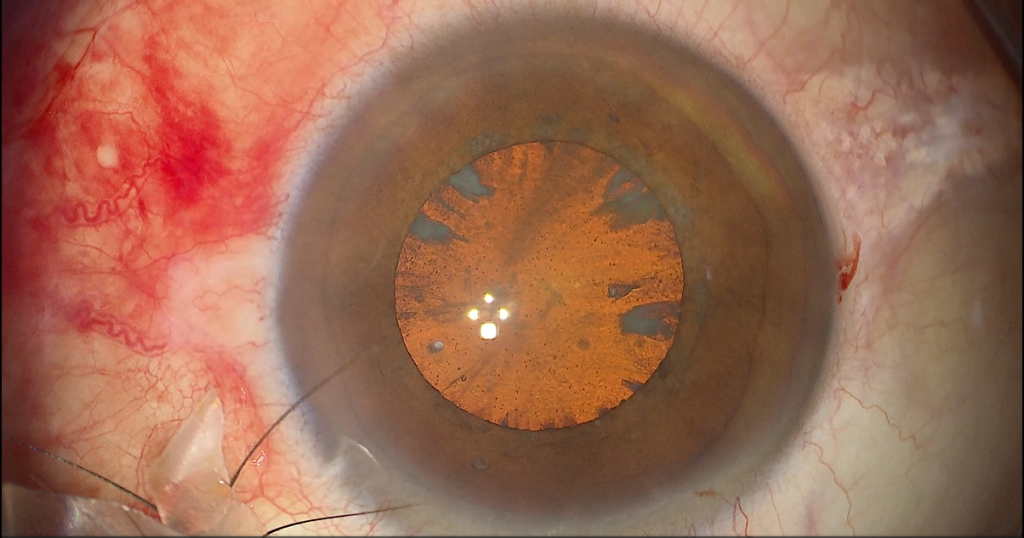
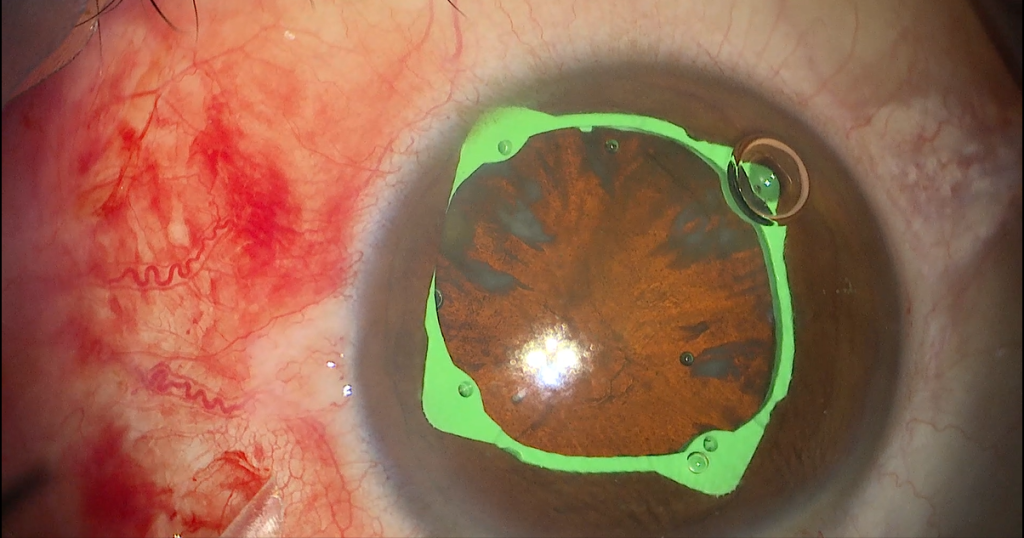
mid sized pupil in a high myope (-12D)
During a complex cataract surgery consultation, Ms Heng starts with a thorough history taking and diagnostic work up. Detailed history will entail
Diagnostic work up will include:
Detailed Pre-Operative Planning
Based on the examination , a risks assessment will be undertaken to determine risks of surgery, expectations and prognosis post surgery and type of suitable intraocular lenses, tailored to you.
In complex cases, Ms Heng usually performs one eye at a time. Majority of cases will be undertaken under sedation but selected cases can still be considered for local anesthesia. Your suitability will be discussed during the consultation.
The surgical procedure and technique will be tailored according to the complexity or needs of the cases to reduce or minimise any risks of complications.
For example, Ms Heng will employ the use special staining methods or advanced techniques such as (this list is nonexhaustive and is used as an example only)
In certain case profile such as advanced macular degeneration, advanced glaucoma, or advanced diabetic retinopathy, cataract surgery will be of guarded prognosis, it may not restore vision loss attributable to the other conditions.
Careful evaluation of the benefits of cataract surgery will be warranted.
Modern cataract surgical techniques have vastly improved the outcomes of cataract surgery. In the UK, we have a UK national cataract audit database that collates and looks at rates of complications across different sites and hospitals. Collated data published indicate that less than 1 in 200 patients now experience severe loss of vision following cataract surgery.
The major complication of cataract surgery, posterior capsular rupture or PCR is now less than 1% of surgeries. This is dependent on individual risk profile, and higher risks or complex cataracts will have a higher risk of surgery.
6/6 vision measures how sharp your eyesight is at a distance of 20 feet or 6 meters compared to someone with normal vision.
This is usually referred to as your distant vision, but your overall visual function also depends on other factors such as peripheral visual fields, depth perception, and colour vision. As much as we talk about the ‘perfect vision’, only approximately 35% of adults naturally see 6/6 without any correction.
Yes, it is possible to achieve 6/6 vision following cataract surgery. However, this is also dependent on every individual patient’s underlying co-morbidities such as diabetes, and/or if they have any ocular pathologies such as diabetic retinopathy, glaucoma, age-related macular degeneration, and high myopia as examples.
The UK National Cataract Audit Database of 55K cataract surgeries have shown that
Hence, the majority of patients will achieve very good functional vision of 6/12 and better and only half will achieve 6/6 vision.
Ms Heng is a complex cataract surgeon. Her case mix over the last 3 quarters has a 50% of patients who have multiple comorbidities including Parkinson’s, diabetes, hypertension and close to 70% with severe ocular co-pathologies including AMD, high myopia, uveitis, diabetic retinopathy, and post vitrectomy as example.
More than 20% of her case mix are brunescent or very advanced cataracts and more than 15% are very high myopia, with axial length (long eyeballs) more than 26mm. These are cases with higher risk of surgical complications.
1. Jaycock P, Johnston RL, Taylor H, Adams M, Tole DM, Galloway P, Canning C, Sparrow JM and the UK EPR User Group. The Cataract National Dataset electronic multi-centre audit of 55 567 operations: updating benchmark standards of care in the United Kingdom and internationally. Eye (2009) 23, 38-49
2. Gale RP, Saldana M, Johnston RL, Zuberbuhler B, McKibbon M. Benchmark standards for refractive outcomes after NHS cataract surgery. Eye (2009) 23, 149-152
Complex cataract surgery is general considered higher risk. It is important to recognise factors and evaluate individual patient risk profile to carefully plan the surgery. In the hands of a capable complex cataract surgeon, advanced techniques may be deployed to mitigate or lessen the risks of surgery.
That said, the evaluation of risks and potential outcome is key and Ms Heng is keen that her patients understands the risks and benefits of the surgery before undertaking it.
In general, the risks of surgery include the following:
After your consultation and confirmation of surgery, you will need a pre operative assessment. The pre assessment can be in person or over the phone, dependent on your medical profile. Following, this, you will be sent information including fasting details, depending on your choice of anesthesia and further details as to whether to stop your usual medical treatment.
On day of surgery, you will first see a member of the nursing team who will check you in and start you on dilating drops in preparation for surgery. Ms Heng and the anaesthetist (if you are having one) will see you prior to the surgery to discuss the surgery again and consent.
After the surgery, you will have a light meal and you will be given further post operative information, and eye drops for your surgery before heading home.
In majority of cases, cataract surgeries, standard or complex cases are day cases.
Ms Heng will undertake detailed history and evaluation of both of your eyes in general to determine suitability of premium intraocular lens such as multifocal or EDOF lens for individual patient.
In some cases, premium lens will not be a suitable option.